Kaolinite Formula, Uses, Structure, Properties & Hardness
Short Intro:
Kaolinite is a versatile clay mineral widely used in ceramics, paper, cosmetics, and agriculture. Understanding its formula, structure, and properties is key for industrial and environmental applications.
What You’ll Learn:
- Chemical composition and formula of kaolinite
- Industrial and agricultural uses
- Layered structure and crystal arrangement
- Pronunciation guide for professionals
- Key physical and chemical properties
- Hardness and impact on applications
1) Introduction: Kaolinite Formula Uses Structure Pronunciation Properties Hardness
Kaolinite formula uses structure pronunciation properties hardness are critical aspects of this widely used clay mineral. Kaolinite, with the chemical formula Al₂Si₂O₅(OH)₄, forms through the weathering of feldspar-rich rocks and is found abundantly worldwide. Its fine particle size, white color, and platy morphology make it a key material in industries such as ceramics, paper, paints, plastics, and cosmetics.
Beyond industrial applications, kaolinite improves soil fertility, enhances water retention, and adsorbs pollutants in environmental remediation projects. Understanding its structure, properties, and physical characteristics allows for efficient utilization in manufacturing, agriculture, and environmental sectors.
This article will explore kaolinite’s chemical formula, industrial uses, crystal structure, pronunciation, key properties, and hardness, offering a comprehensive overview for professionals and enthusiasts alike.
2) Kaolinite Formula
Kaolinite formula: Al₂Si₂O₅(OH)₄
SEO Snippet: Kaolinite’s chemical formula Al₂Si₂O₅(OH)₄ reflects its layered silicate structure and industrial versatility.
Kaolinite is an aluminum silicate hydroxide clay mineral with the formula Al₂Si₂O₅(OH)₄, belonging to the phyllosilicate group. It is formed via the chemical weathering of feldspar-rich rocks such as granite and gneiss, where alkaline elements are leached and kaolinite precipitates in stable, low-energy environments.
Its structure, composed of aluminum, silicon, oxygen, and hydroxyl groups, gives it distinctive characteristics, including fine particle size, platy morphology, and white coloration. These properties are fundamental to its applications in ceramics, paper coatings, paints, plastics, and cosmetic products.
Kaolinite is also important for agriculture due to its ability to improve soil water retention and act as an adsorbent for pollutants. Its widespread occurrence and economic significance make it a key mineral in both industrial and environmental sectors.
LSI Keywords: Al₂Si₂O₅(OH)₄, clay mineral formula, kaolin chemical composition, phyllosilicate, feldspar weathering, industrial clay, kaolinite chemical formula
External links:
- Mindat.org – Kaolinite Mineral
- USGS Kaolin Minerals Overview
Novin Trades Market View: Kaolinite continues to see stable demand in ceramics and paper industries, with emerging interest in sustainable agricultural applications.
3) Kaolinite Uses
Kaolinite uses: versatile industrial and agricultural applications
SEO Snippet: Kaolinite is widely used in ceramics, paper, cosmetics, and soil improvement due to its fine particle size and whiteness.
Kaolinite’s unique properties make it a multifunctional material across various industries:
- Ceramics: Provides strength, whiteness, and translucency for porcelain, tiles, and pottery.
- Paper Industry: Improves opacity, smoothness, and printability in coated papers.
- Paints and Coatings: Acts as a filler to enhance texture, opacity, and durability.
- Rubber and Plastics: Reinforces mechanical properties, improving tensile strength and dimensional stability.
- Cosmetics: Used in face masks, powders, and soaps due to its gentle texture and oil-absorbing ability.
- Agriculture: Enhances soil water retention, nutrient exchange, and aeration.
- Pharmaceuticals & Pet Food: Functions as an excipient and anti-caking agent.
Kaolinite’s versatility ensures its continued relevance in both traditional industries and emerging environmental technologies.
LSI Keywords: kaolin uses, clay industrial applications, kaolinite in cosmetics, paper filler, ceramic clay, soil amendment, kaolinite agriculture
External links:
- ScienceDirect – Kaolinite Applications
- ResearchGate – Kaolinite Industrial Use
Novin Trades Market View: Growth in coated paper and ceramics markets drives consistent demand for high-purity kaolinite globally.
4) Kaolinite Structure
Kaolinite structure: layered tetrahedral and octahedral sheets
SEO Snippet: Kaolinite’s layered structure of silica and alumina sheets underlies its industrial applications and unique physical properties.
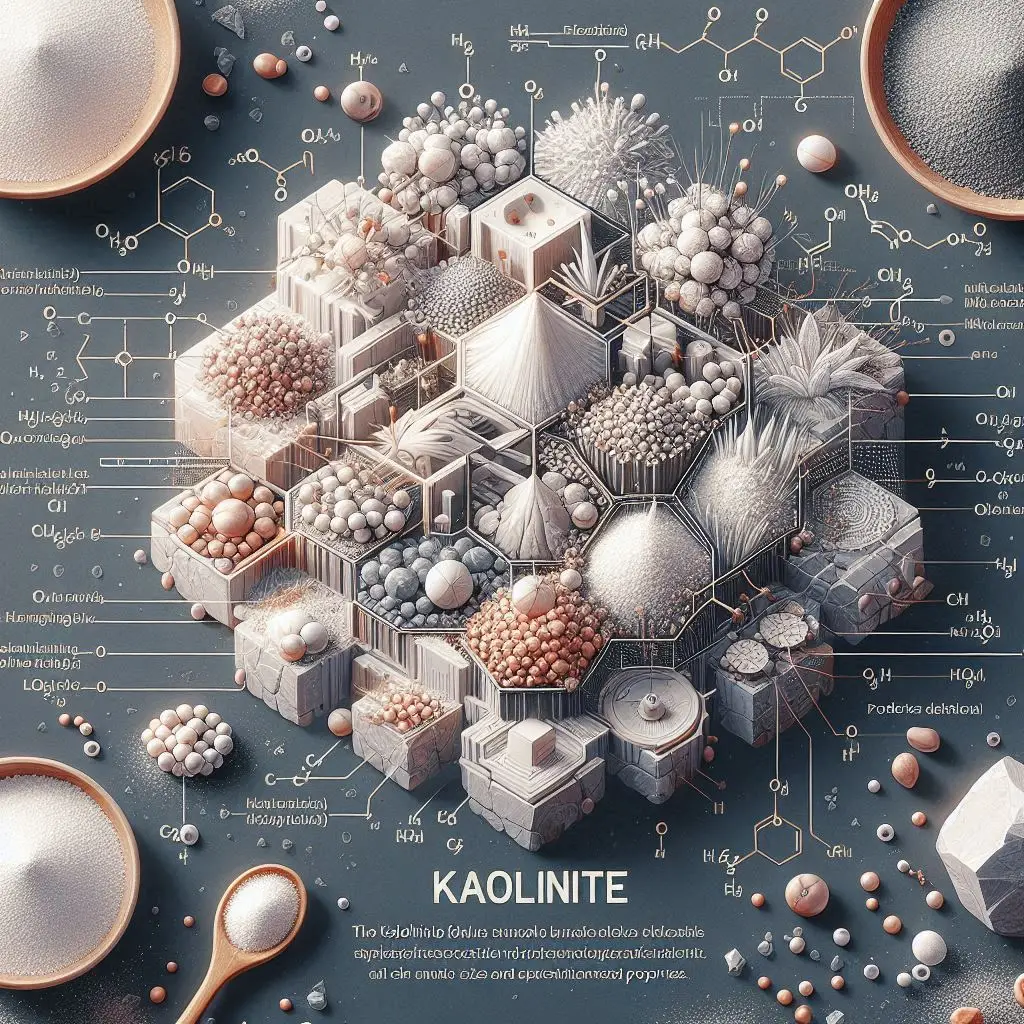
Kaolinite is a 1:1 layered clay mineral, with a tetrahedral silica sheet bonded to an octahedral alumina sheet. Hydrogen bonds and van der Waals forces hold these sheets together, giving kaolinite its soft, platy texture.
- Tetrahedral Sheet: Silicon atoms coordinated with four oxygen atoms, forming a hexagonal lattice.
- Octahedral Sheet: Aluminum atoms coordinated with oxygen and hydroxyl groups.
- Layering: Hydrogen bonds link sheets, providing stability and enabling smooth texture and adsorption capabilities.
This layered structure contributes to kaolinite’s suitability for ceramics, paper coatings, paints, and environmental remediation applications.
LSI Keywords: kaolinite lattice, 1:1 clay mineral, tetrahedral silica sheet, octahedral alumina sheet, hydrogen bonding in kaolinite, phyllosilicate structure
External links:
- Minerals Education Coalition – Kaolinite Structure
Novin Trades Market View: Layered kaolinite enhances adsorption in environmental applications, increasing its demand in water treatment projects.
5) Kaolinite Pronunciation
Kaolinite pronunciation: “kay-oh-luh-nite”
SEO Snippet: Pronouncing kaolinite correctly ensures professional communication in geology and industrial discussions.
Kaolinite is pronounced “kay-oh-luh-nite”, with emphasis on the second syllable. Proper pronunciation is essential for geologists, mineralogists, and industrial professionals, ensuring clarity in presentations, reports, and academic discussions.
- Kay – long “A” as in “kite”
- Oh – long “O” as in “go”
- Luh – short “U” as in “luck”
- Nite – rhymes with “night”
Clear pronunciation enhances credibility and avoids miscommunication in scientific and industrial contexts.
LSI Keywords: kaolinite pronunciation guide, clay mineral pronunciation, geology terminology, professional pronunciation
External links:
6) Kaolinite Properties
Kaolinite properties: absorbent, thermally stable, low shrink-swell
SEO Snippet: Kaolinite’s properties, including absorbency, whiteness, and thermal stability, drive its diverse industrial applications.
Key properties include:
- Chemical Composition: Al₂Si₂O₅(OH)₄
- Crystal Structure: Layered tetrahedral-alumina sheets
- Hardness: Mohs 2
- Color: White to light gray
- Absorbent Nature: Enhances papermaking, ceramics, and paints
- Thermal Stability: Resistant up to 600°C, suitable for high-temperature processes
- Electrical Insulation: Low conductivity, useful in electrical applications
- Environmental Applications: Adsorbs heavy metals and pollutants
Kaolinite’s combination of chemical and physical properties makes it indispensable in industrial, agricultural, and environmental sectors.
LSI Keywords: kaolinite chemical properties, clay thermal stability, absorbent clay mineral, phyllosilicate properties, kaolinite environmental use
External links:
Novin Trades Market View: Advanced applications in water treatment and high-performance ceramics continue to expand kaolinite’s market potential.
7) Kaolinite Hardness
Kaolinite hardness: Mohs scale 2, soft and workable
SEO Snippet: Kaolinite’s softness (Mohs 2) makes it easy to process but limits use in high-abrasion applications.
With a Mohs hardness of 2, kaolinite is soft and easily scratched. This property allows easy milling and shaping for ceramics, paper, and cosmetics. However, low hardness limits its use in applications requiring durability or abrasion resistance.
Advantages: Easy processing, smooth texture, moldability.
Limitations: Susceptibility to wear, limited use in heavy-duty applications.
LSI Keywords: kaolinite softness, Mohs 2 mineral, clay workability, industrial clay hardness
External links:
Conclusion: Kaolinite Formula Uses Structure Pronunciation Properties Hardness
Kaolinite formula uses structure pronunciation properties hardness are essential to understanding this versatile clay mineral. Its chemical formula Al₂Si₂O₅(OH)₄, layered structure, and unique properties underpin applications in ceramics, paper, cosmetics, agriculture, and environmental remediation. Its softness (Mohs 2) facilitates processing while posing limits for high-wear uses.
Understanding kaolinite’s characteristics supports efficient industrial utilization, agricultural benefits, and environmental solutions. For deeper insights and industry analysis, explore NovinTrades Reportages and related materials.
LSI Keywords: kaolinite industrial use, clay mineral properties, kaolinite structure, phyllosilicate applications, Al₂Si₂O₅(OH)₄
External links:
- USGS Kaolin Minerals Overview
- Mindat.org – Kaolinite Mineral
About NovinTrades
As part of its mission, NovinTrades offers a dedicated Reportage section where businesses, brands, and professionals can publish in-depth sponsored articles, analyses, and thought-leadership pieces. These reportages are SEO-optimized for maximum visibility and long-term engagement.
📍 Explore more at NovinTrades Reportages
📣 Join us on Telegram: https://t.me/novintrades