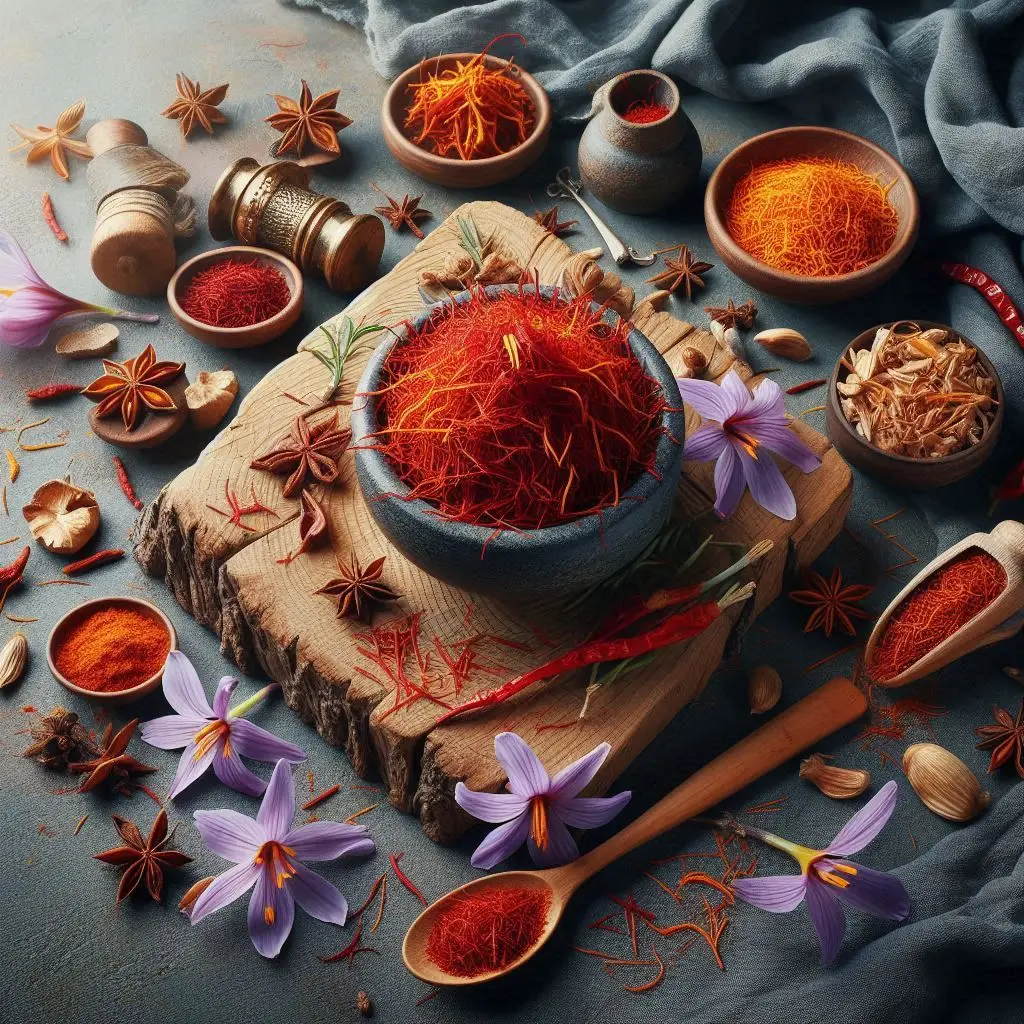
Saffron Price, History & Lubbock Herb Insights – December 27, 2025
Short Intro
December 27 is where sentiment changes but fundamentals do not. The Christmas lull fades, traders return, logistics queues reappear, and saffron ends the year exactly where it always does: immune to seasonal optimism and largely indifferent to short-term market psychology.
Unlike grains, oils, or even most spices, saffron does not experience a meaningful “year-end correction.” There is no surplus release, no warehouse drawdown that suddenly changes supply dynamics. What exists on December 27 is what existed on December 25, and largely what existed in October after harvest: a tightly constrained, labor-bound supply chain meeting demand that refuses to disappear.
As of late December 2025, saffron remains the clearest example of a commodity whose value is anchored not in futures curves or speculative positioning, but in human limitation. Every strand still represents minutes of manual labor, harvested within a narrow biological window, from a flower that offers no scalability.
This is why looking at saffron through both historical Europe and modern America still matters. Saffron Walden explains how spice scarcity once shaped entire towns and trade routes. Lubbock, Texas explains how modern spice economies thrive without trying to imitate that scarcity. Together, they reveal why saffron remains expensive, relevant, and structurally misunderstood.
What You’ll Learn
- Why saffron still dominates the global spice value hierarchy
- How saffron prices evolved historically and where they stand as of December 27, 2025
- Whether saffron is technically an herb or functionally a spice
- The economic legacy of Saffron Walden and why it still matters
- How Lubbock fits into today’s spice economy without producing saffron
- The forces shaping saffron pricing into early 2026
1) Introduction: Saffron Most Expensive Spice and Lubbock Herb
Saffron exists in a category of its own because it refuses efficiency. Modern agriculture excels at scale, mechanization, yield optimization, and labor replacement. Saffron accepts none of this.
Each gram remains dependent on hand-harvested stigmas, collected at dawn, over a flowering period that lasts barely a few weeks per year. No meaningful mechanization has emerged. No genetic shortcut has rewritten the yield equation. The biological ceiling is fixed, and human labor fills the gap.
By December 27, 2025, this reality is impossible to ignore. While global commodity desks rotate toward 2026 outlooks, saffron supply remains frozen in its physical constraints. There is no “next quarter” fix.
In contrast, Lubbock represents the modern spice economy at its most rational. It produces, processes, blends, distributes, and consumes spices that fit climate, cuisine, and logistics. It does not chase symbolic rarity. It monetizes integration.
Saffron and Lubbock illustrate two ends of the same market truth: value can come from scarcity, or it can come from system efficiency. Saffron simply happens to be the purest expression of the former.
2) Saffron Most Expensive Spice
SEO Snippet: Saffron commands the highest prices among spices due to manual harvesting, limited growing regions, and resilient culinary and medicinal demand.
Saffron comes from Crocus sativus, a sterile plant that reproduces only through human intervention. Each flower produces three stigmas. That is the entire output. No yield surprises. No upside optionality.
To produce one kilogram of dried saffron, approximately 150,000 to 200,000 flowers must be harvested and processed by hand. This fact alone permanently fixes saffron’s cost structure above any mechanized crop.
Indicative Global Price Ranges – December 27, 2025
- Commercial grade: USD 1,200–1,800 per pound
- High-grade culinary: USD 2,500–3,500 per pound
- Premium Iranian, Kashmiri, Spanish, Greek: USD 4,000–5,500+ per pound
Iran continues to supply more than 85% of global production, followed by India (Kashmir), Afghanistan, Spain, and Greece. However, the concentration itself adds risk:
- Labor costs continue rising faster than local currency depreciation
- Climate volatility increases yield uncertainty
- Export and payment restrictions complicate trade flows
- Quality dispersion remains wide, reinforcing premium pricing
Demand remains strong because saffron’s value is not just sensory. Its chemical profile supports expanding non-culinary use:
- Crocin: pigmentation and antioxidant effects
- Safranal: aroma and neurological interaction
- Picrocrocin: flavor depth and bitterness
These compounds are driving growth in supplements, functional foods, and wellness formulations. That demand does not retreat just because prices are high.
Section Summary:
By late December 2025, saffron prices remain firm because they are structurally justified. Scarcity is real, not marketed.
3) Saffron Herb or Spice
SEO Snippet: Botanically an herb but commercially and culturally a spice, saffron defies simple classification.
Botanically, saffron originates from a flowering plant, which technically places it in herb territory. Practically, that classification is useless.
Saffron behaves like a luxury spice in every meaningful way:
- It is dried and stored long-term
- It is consumed in milligram quantities
- It is priced by gram, not bunch or volume
- It carries medicinal, ceremonial, and cultural value
Its market behavior aligns with vanilla and cardamom, not leafy herbs. Regulation, packaging, pricing, and usage all reinforce its spice identity.
Section Summary:
Saffron’s ambiguous classification reinforces its mystique. It resists tidy categories because its economic behavior is exceptional.
4) Saffron Walden Saffron Spice
SEO Snippet: Saffron Walden’s medieval spice trade shaped long-term economic and cultural identity.
Saffron Walden was not named whimsically. During the 16th and 17th centuries, saffron production transformed the town into a center of agricultural wealth. Trade revenues funded architecture, civic institutions, and regional influence.
Eventually, England lost its competitive edge. Climate constraints, labor costs, and cheaper imports shifted production elsewhere. Yet the imprint of saffron remains embedded in the town’s identity.
As of December 2025, Saffron Walden serves as a reminder that before derivatives and exchanges, spice scarcity created real wealth, real infrastructure, and lasting cultural memory.
Section Summary:
Saffron Walden proves that agricultural scarcity once functioned as economic power, not nostalgia.
5) Saffron and Spice in Lubbock
SEO Snippet: Lubbock thrives in spice markets through agriculture, processing, and culinary integration rather than luxury production.
Lubbock does not grow saffron, and there is no economic reason it should. Instead, it excels where logic applies:
- Chili peppers
- Cumin
- Coriander
- Paprika
- Garlic
- Tex-Mex and Southwestern blends
Its strengths include agricultural scale, processing infrastructure, and access to U.S. distribution networks. Saffron enters Lubbock as an imported specialty, used sparingly and intentionally.
This is modern spice economics: efficiency over symbolism.
Section Summary:
Lubbock demonstrates that relevance in spice markets comes from use, not myth.
6) Saffron Spice Price Outlook
SEO Snippet: Saffron prices remain structurally elevated into 2026 due to labor, climate, and demand rigidity.
As December 2025 closes, saffron pricing remains shaped by forces that do not reset on January 1:
- Fully manual harvesting
- Narrow biological production windows
- Climate stress in key regions
- Geopolitical and payment risks
- Expanding wellness and pharmaceutical interest
Saffron demand is notably price-inelastic. Consumption persists because substitution is limited and quantities are small relative to value.
Looking into early 2026, upside pressure remains more likely than downside relief.
Section Summary:
Saffron is expensive because it cannot be made cheaper without breaking its biology.
7) Conclusion: Saffron Most Expensive Spice and Lubbock Herb
As of December 27, 2025, saffron’s position at the top of the spice hierarchy remains intact and unchallenged. The holidays bring reflection, not repricing.
From the medieval prosperity of Saffron Walden to the pragmatic spice economy of Lubbock, saffron’s story exposes a simple truth: value emerges where human effort meets irreplaceable limitation.
Saffron endures because it refuses acceleration. It remains expensive because it remains human.
About NovinTrades
NovinTrades operates a dedicated Reportage section where companies, traders, and analysts publish in-depth, SEO-optimized articles on commodities, energy markets, and global trade dynamics. These reports are designed for long-term visibility, authority, and professional credibility.
📍 Explore more at NovinTrades Reportages
📣 Join the Telegram channel: https://t.me/novintrades