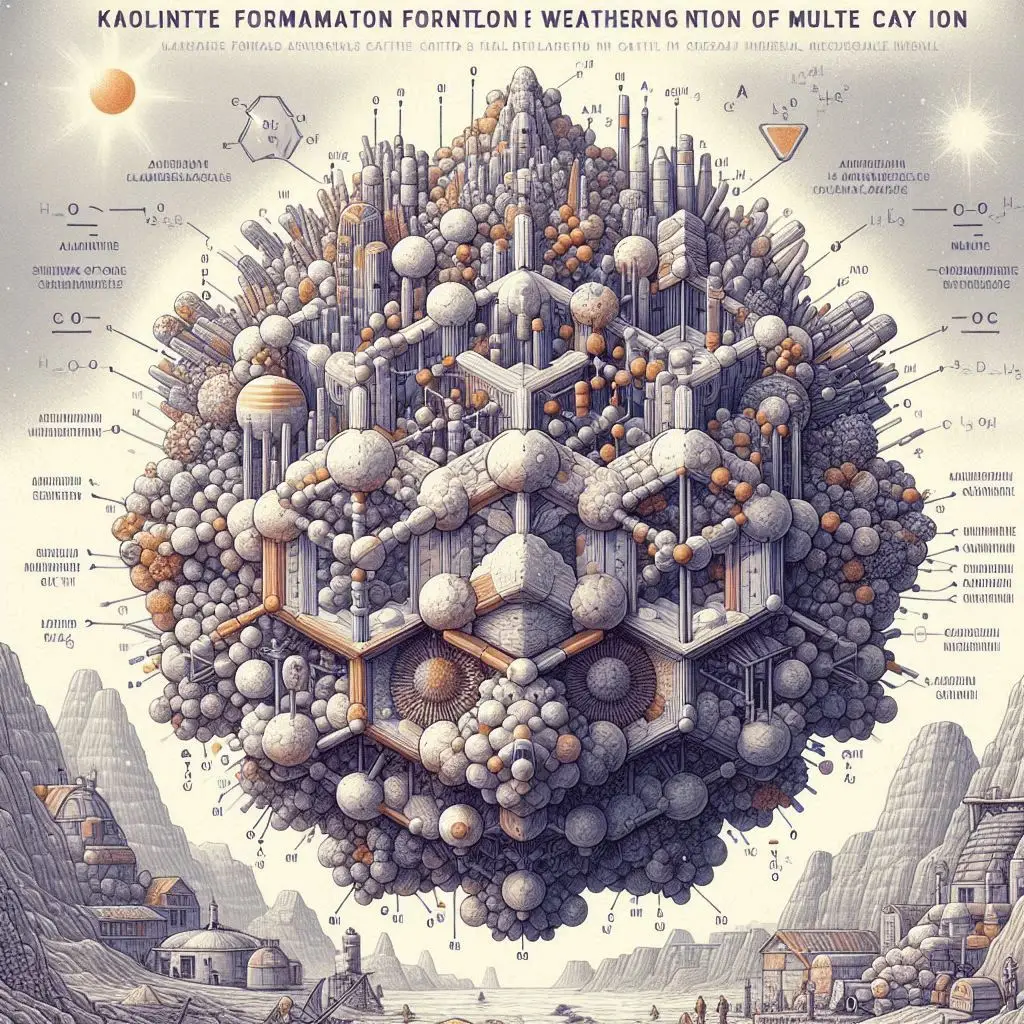
Kaolinite Formation, Weathering & Mullite Transformation
Short Intro
Kaolinite is one of the most influential clay minerals shaping geology, industry, and materials science.
This guide explores its formation, weathering pathways, and transformation into mullite.
What You’ll Learn
- How kaolinite forms through chemical weathering processes
- The crystal chemistry and formulation principles of kaolinite clay
- The kaolinite-to-mullite transformation in high-temperature systems
- Industrial formulation, beneficiation, and calcination methods
- The role of kaolinite ions in soils, sediments, and materials science
1) Introduction to Kaolinite Systems
Introduction to Kaolinite Systems
SEO Snippet:
Kaolinite is a layered aluminosilicate clay mineral essential to geology, ceramics, refractories, and modern industrial formulations.
Section Summary:
Kaolinite, chemically defined as Al₂Si₂O₅(OH)₄, is a naturally occurring clay mineral formed primarily through long-term chemical weathering of feldspar-rich rocks. Its low shrink–swell capacity, thermal stability, and chemical inertness make it a cornerstone material across ceramics, paper, coatings, refractories, and environmental sciences. Beyond industrial relevance, kaolinite plays a foundational role in soil development, sedimentary rock formation, and surface geochemistry. Understanding its formation, transformation, and ionic behavior provides insight into both Earth systems and advanced material engineering, setting the stage for deeper exploration of its formulation and weathering mechanisms.
Keywords: kaolinite clay, aluminosilicate mineral, clay mineralogy, industrial clay
External Link:
- https://www.britannica.com/science/kaolinite
Novin Trades Market View and Forecast:
Demand for refined kaolinite continues to rise, driven by ceramics, refractories, and high-performance fillers, particularly in Asia and the Middle East.
2) Kaolinite Formulation and Crystal Chemistry
Kaolinite Formulation and Crystal Chemistry
SEO Snippet:
Kaolinite formulation depends on its layered crystal structure, purity, particle size, and controlled processing techniques.
Section Summary:
Kaolinite’s defining feature is its 1:1 layered structure, consisting of one silica tetrahedral sheet bonded to one alumina octahedral sheet. This configuration results in strong hydrogen bonding between layers, giving kaolinite its low plasticity and minimal expansion under moisture variation. Industrial formulation focuses on optimizing brightness, particle size distribution, and aspect ratio through beneficiation and grinding. These properties directly influence performance in paper coating, ceramics, paints, rubber, plastics, and pharmaceutical excipients, where consistency and chemical stability are critical.
Keywords: kaolinite formulation, crystal structure, layered silicate, industrial minerals
External Link:
- https://pubs.usgs.gov/fs/kaolin/
Novin Trades Market View and Forecast:
High-purity kaolinite grades command premium pricing, especially for paper and technical ceramics, with steady long-term growth expected.
3) Kaolinite Formation Through Weathering
Kaolinite Formation Through Weathering
SEO Snippet:
Kaolinite forms via prolonged chemical weathering of feldspar minerals under acidic, humid environmental conditions.
Section Summary:
Kaolinite formation begins when feldspar-rich rocks undergo hydrolysis and dissolution in the presence of water, carbon dioxide, and weak organic acids. Alkali and alkaline-earth cations are leached, leaving behind aluminum- and silica-rich residues. Under suitable pH conditions and sustained leaching, these components reorganize into the stable kaolinite structure. Warm, humid climates accelerate this process, explaining the abundance of kaolinite in tropical and subtropical soils. This weathering pathway is central to soil fertility, sediment transport, and landscape evolution.
Keywords: chemical weathering, feldspar alteration, soil formation, secondary minerals
External Link:
- https://www.sciencedirect.com/topics/earth-and-planetary-sciences/kaolinite
Novin Trades Market View and Forecast:
Regions with intense weathering profiles remain strategic sources for kaolinite feedstock, influencing global supply chains.
4) Kaolinite to Mullite Transformation
Kaolinite to Mullite Transformation
SEO Snippet:
The kaolinite-to-mullite transformation is a high-temperature process vital for refractory and advanced ceramic applications.
Section Summary:
When kaolinite is heated beyond approximately 450°C, dehydroxylation occurs, forming metakaolinite. Further heating between 1000°C and 1200°C induces atomic rearrangement, resulting in mullite formation. Mullite is prized for its exceptional thermal stability, low thermal expansion, and resistance to chemical attack. This transformation underpins the manufacture of refractories, kiln linings, and advanced ceramics. Process variables such as particle size, impurity content, and heating rate strongly influence mullite morphology and performance.
Keywords: mullite formation, metakaolinite, refractory materials, thermal transformation
External Link:
- https://ceramics.org/ceramic-tech-today/mullite
Novin Trades Market View and Forecast:
Mullite-based materials are experiencing sustained demand growth in steel, glass, and energy-intensive industries.
5) Kaolinite Clay Processing and Formulation
Kaolinite Clay Processing and Formulation
SEO Snippet:
Industrial kaolinite clay formulation involves mining, beneficiation, grinding, classification, and optional calcination.
Section Summary:
Kaolinite clay processing begins with selective mining, followed by beneficiation techniques such as washing, screening, and flotation to remove impurities. Drying and grinding enhance surface area and functional performance, while particle size classification tailors grades for specific industries. Calcination modifies physical and chemical properties, producing calcined kaolin used extensively in polymers, paints, and rubber. Blending with minerals like quartz or feldspar further customizes performance characteristics, ensuring compatibility with diverse industrial applications.
Keywords: kaolinite clay formulation, beneficiation, calcined kaolin, industrial processing
External Link:
- https://www.mineralseducationcoalition.org/minerals-database/kaolin/
Novin Trades Market View and Forecast:
Processed and calcined kaolinite products continue to outperform raw clay in value-added export markets.
6) Kaolinite Ion Formation and Environmental Role
Kaolinite Ion Formation and Environmental Role
SEO Snippet:
Kaolinite ion formation results from feldspar hydrolysis, influencing soil chemistry, sedimentation, and nutrient retention.
Section Summary:
Kaolinite ions originate during chemical weathering when feldspar minerals undergo dissolution and hydrolysis. Released silica and alumina species nucleate and grow into kaolinite crystals, eventually forming clay-sized particles. These particles contribute significantly to soil structure, water retention, and nutrient availability. In sedimentary environments, kaolinite influences permeability and mechanical behavior, making it relevant to agriculture, hydrogeology, and civil engineering. Its low cation-exchange capacity also provides chemical stability in sensitive environments.
Keywords: kaolinite ions, soil chemistry, clay minerals, sedimentary processes
External Link:
- https://www.nature.com/articles/s41467-019-10276-8
Novin Trades Market View and Forecast:
Environmental and agricultural applications of kaolinite are gaining attention amid sustainability-driven material selection.
Conclusion: Integrated View of Kaolinite Systems
Integrated View of Kaolinite Systems
SEO Snippet:
Kaolinite links geological weathering, industrial formulation, and advanced ceramic transformation into a single mineral system.
Section Summary:
Kaolinite stands at the intersection of Earth science and industrial innovation. From its formation through chemical weathering to its controlled transformation into mullite, kaolinite underpins critical applications across construction, manufacturing, agriculture, and advanced materials. Its versatility, abundance, and stability ensure ongoing relevance as industries seek efficient, high-performance, and sustainable mineral solutions. Continued research and processing innovation will further expand kaolinite’s role in global material supply chains.
Keywords: kaolinite applications, clay mineral systems, industrial minerals
External Links:
- https://www.britannica.com/science/clay-mineral
- https://www.sciencedirect.com/topics/materials-science/kaolin
Readers are invited to explore more in-depth analyses and industry insights in the NovinTrades Articles and Reportage sections.
About NovinTrades
As part of its mission, NovinTrades offers a dedicated Reportage section where businesses, brands, and professionals can publish in-depth sponsored articles, analyses, and thought-leadership pieces. These reportages are SEO-optimized for maximum visibility and long-term engagement.
📍 Explore more at NovinTrades Reportages
📣 Join us on Telegram: https://t.me/novintrades
Reportage Section
As part of this mission, NovinTrades also offers a dedicated Reportage section, where businesses, brands, and industry professionals can publish in-depth sponsored articles, analyses, and thought-leadership pieces. This section is designed to boost online visibility, strengthen brand authority, and drive meaningful engagement with target audiences. Reportages are optimized for SEO and strategically placed on our platform, ensuring long-term exposure to decision-makers and potential buyers across industries.
Visit: https://www.novintrades.com/reportages
Join our Telegram: https://t.me/novintrades