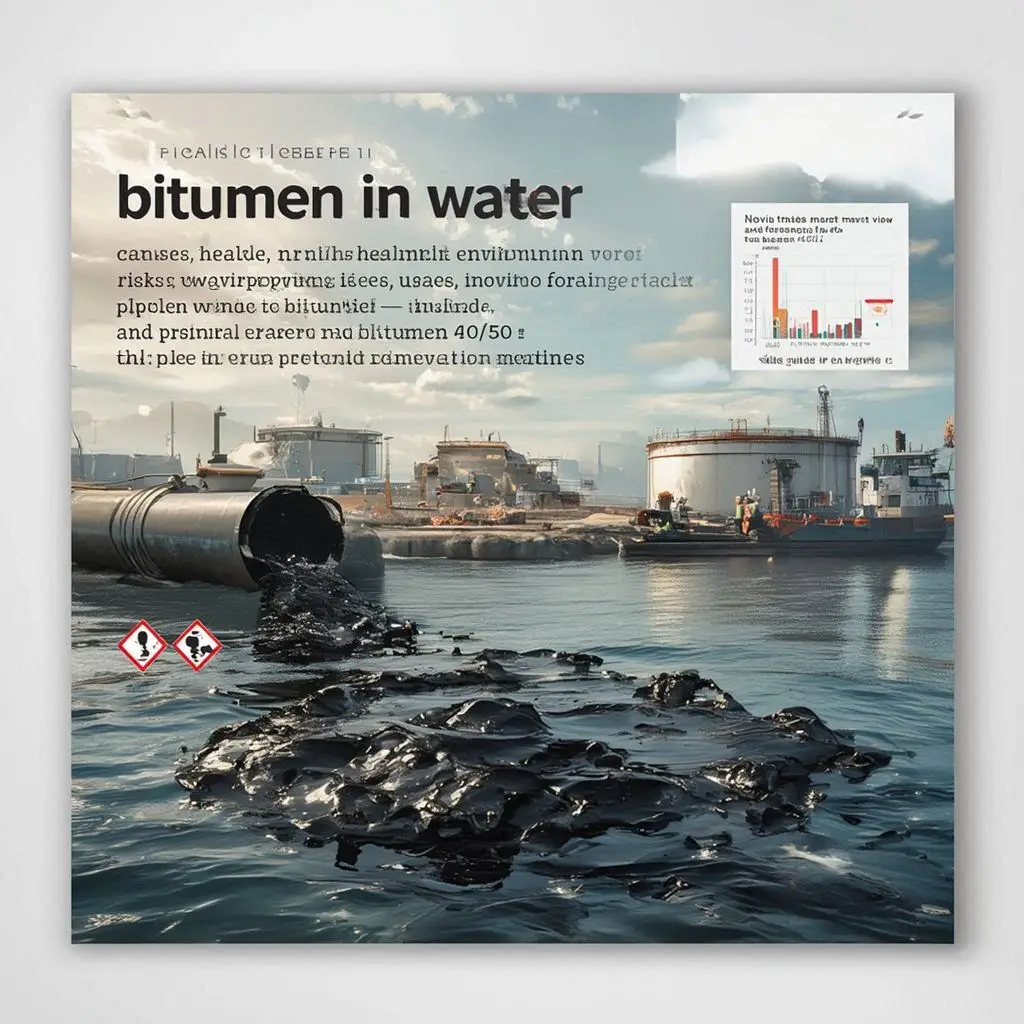
Bitumen in water — causes, risks, uses & prevention
Short intro :
Bitumen in water is an increasingly discussed issue across construction, shipping and water-supply sectors — from accidental contamination to deliberate use in waterproofing. This guide explains causes, impacts, detection and safe practices, and links the topic to common commercial grades such as bitumen 40/50.
WHAT YOU’LL LEARN
- How bitumen enters water and the typical pathways.
- Environmental and human-health risks, and practical mitigation measures.
- Use cases: waterproofing, tanks, pipes, and supply systems.
- Relation to commercial grades (bitumen 40/50, 60/70, 80/100) and market outlook.
KEY STATISTICS (OUTPUT, RESERVES, VACANCIES)
- Global bitumen production is dominated by refineries and oil-sands regions (quantities vary by year and country).
- Major commercial demand sectors: road paving, roofing/waterproofing, industrial membranes.
- Vacancy/skill gaps: demand for qualified applicators (membrane installers) remains high in many markets.
(Exact production/reserve numbers vary by region and year — check local industry reports for current figures.)
1) INTRODUCTION
SEO snippet: Introduction: overview of why bitumen-in-water matters for environment, infrastructure and industry.
Bitumen — a viscous, complex mixture of hydrocarbons — is essential to many industries but problematic when it contaminates water. Whether from accidental spills, leaching from storage, improper waterproofing execution, or runoff from paved areas, bitumen in water creates technical, legal and environmental challenges. This article breaks the issue down into causes, consequences, practical controls and market context (including bitumen 40/50).
External links (examples of reputable resources):
https://en.wikipedia.org/wiki/Bitumen
https://www.epa.gov/oil-spills-prevention-and-preparedness-response
2) 1) BITUMEN IN WATER
SEO snippet: What “bitumen in water” looks like — from emulsions to tar balls — and how it behaves in aquatic systems.
Bitumen can be present in water as free-phase blobs (tar balls), dispersed droplets, or emulsions (bitumen + water stabilized by natural surfactants). Its behavior depends on temperature, particle size and grade — lighter components can volatilize, heavier fractions sink or adhere to sediments. Fresh spills often form surface slicks; older residues form tarry residues that persist. Understanding these forms helps in designing clean-up and monitoring strategies.
LSI keywords: tar balls, bitumen emulsion, oil-in-water, hydrocarbon slicks, persistent organic residues.
External links:
https://www.noaa.gov/emergency-response (NOAA resources on marine oil behavior)
https://www.who.int (look up health guidance on hydrocarbon exposure)
3) 2) BITUMEN IN WATERPROOFING
SEO snippet: How bitumen is used in waterproofing (membranes, coatings) and why proper application prevents water contamination.
Bitumen-based membranes and coatings (including modified bitumen) are widely used for roofing and below-grade waterproofing because of their water resistance and adhesion. Properly cured and installed systems are designed not to release bitumen into water. Problems appear when: low-grade products are used, overheating occurs during torch-on application, or drainage/water-runoff details are incorrect — causing bitumen wash-off into stormwater systems.
Practical takeaway: Use certified materials (e.g., SBS- or APP-modified membranes), ensure correct curing, and protect runoff during installation.
Relation to bitumen 40/50: Bitumen 40/50 is a penetration-grade commonly used for waterproofing membranes and industrial coatings; its physical properties (softness at ambient) influence handling and susceptibility to wash-off during faulty application.
External links:
https://www.iso.org/ (search for waterproofing and bitumen standards)
https://www.astm.org/ (standards on modified bitumen roofing)
4) 3) BITUMEN IN WATER MEANING
SEO snippet: Clarifies definitions and regulatory framing — when is bitumen presence a contamination event versus a functional use?
“Bitumen in water” can mean contamination (unintended release) or an engineered, contained presence (e.g., emulsions made for industrial use). Regulatory bodies usually treat unplanned presence as pollution triggering reporting and remediation. Detection limits, sampling methodology and legal thresholds differ by jurisdiction — but the core concern is mobility of hydrocarbons, toxicity to aquatic life, and persistence in sediments.
LSI keywords: contamination thresholds, hydrocarbon monitoring, environmental legislation, emulsion use.
External links:
https://www.epa.gov (environmental guidelines for hydrocarbons)
https://www.who.int (public health context for contaminants)
5) 4) BITUMEN IN WATER PIPE
SEO snippet: Causes, detection and fixes for bitumen contamination inside water pipes.
Bitumen may enter potable or process piping via: cross-contamination during maintenance, leaks from adjacent tanks/pipes, or improper cleaning of transport lines previously used for bitumen grades. In pipes, bitumen causes clogging, biofilm change and taste/odor problems. Remediation includes mechanical cleaning, hot-water/steam flushing, chemical detergents (approved for the system), and replacement of affected pipe sections for severe cases.
Prevention tips: Maintain strict line-use segregation, label transport lines, flush after product changes, and avoid storing bitumen near potable-water infrastructure.
LSI keywords: pipeline contamination, pipe flushing, line pigging, cross-contamination controls.
External links:
https://www.ipieca.org/ (industry guidance on oil & water interfaces)
https://www.who.int/ (drinking-water safety guidance)
6) 5) BITUMEN IN WATER TANK
SEO snippet: Risks and controls when bitumen is stored near or inside tanks that contact water.
Storage tanks that hold bitumen (hot or cold) require secondary containment and drainage design that prevents runoff into water tanks. Bitumen in water tanks typically results from overflow, cross-connection, or seepage from shared bunds. If bitumen reaches potable water tanks, immediate isolation and professional remediation are required — including decommissioning, internal cleaning, and testing to verify safety before return to service.
Operational controls: physical separation, dedicated bunds, routine bund inspections, and clear valve and piping labeling.
LSI keywords: tank bunding, secondary containment, tank cleaning, decontamination.
External links:
https://www.hse.gov.uk/ (UK Health & Safety Executive guidance on storage and bunds)
https://www.novintrades.com/products/32?title=bitumen-6070 (Novin Trades bitumen product example)
7) 6) BITUMEN IN WATER SUPPLY
SEO snippet: How bitumen presence affects municipal/industrial water supplies and response frameworks.
When bitumen contaminates supply systems, priority actions are: isolate affected zones, notify public health and environment authorities, suspend use (if potable), and start remediation. Long-term, utilities update asset protection and monitoring programs. Community communication and documented test results are essential to maintain trust.
LSI keywords: water safety, utility incident response, sampling and lab testing, public advisories.
External links:
https://www.who.int/water_sanitation_health (WHO water safety planning)
https://www.epa.gov/water-research (US EPA water research)
8) 7) HEALTH & ENVIRONMENTAL IMPACTS OF BITUMEN IN WATER
SEO snippet: Short- and long-term ecological and human health considerations when bitumen contaminates water bodies.
Bitumen contains complex hydrocarbons — some fractions are toxic to aquatic organisms, can smother benthic habitats, and bioaccumulate in sediments. Human exposure risks are primarily via contaminated fish/seafood, dermal contact, or inhalation of volatiles near fresh spills. Chronic residues in sediments may persist for years, necessitating sediment remediation programs in severe cases.
Mitigation: containment booms, skimming emulsions, sediment dredging (when needed), and monitored natural recovery where appropriate.
LSI keywords: ecotoxicology, bioaccumulation, sediment remediation, oil spill response.
External links:
https://response.restoration.noaa.gov/ (NOAA restoration and response resources)
https://www.unep.org/ (UN Environment Programme oil pollution info)
9) 8) PREVENTION, MONITORING & BEST PRACTICES
SEO snippet: Practical measures to prevent bitumen from reaching water and to monitor risks effectively.
Best practices include: risk assessments for storage/handling, proper secondary containment, stormwater controls, certified materials for waterproofing applications, staff training, line segregation, routine inspections, and environmental monitoring (surface water, sediments, and stormwater). Use of quality grades such as bitumen 40/50 should align with application requirements and temperature-control measures to reduce accidental wash-off.
Monitoring technologies: oil-in-water sensors, periodic lab sampling, visual inspections after storms, and remote telemetry for tank levels.
LSI keywords: stormwater best management practices, oil-in-water analyzers, containment booms, environmental monitoring.
External links:
https://www.iso.org/ (standards on storage, handling and environmental management)
https://www.novintrades.com/products/31?title=bitumen-80-100 (Novin Trades product reference)
NOVIN TRADES — INTRODUCTION (BRAND SECTION)
SEO snippet: NovinTrades — a B2B marketplace for oil products, bitumen grades and industry reportage.
NovinTrades is building a next-generation B2B marketplace connecting buyers and sellers of oil products, chemicals, minerals and building materials. The platform lists bitumen products (e.g., 60/70, 80/100, 40/50) and provides market intelligence, reportages and supplier contacts. For procurement teams seeking reliable suppliers or to read in-depth analyses, NovinTrades is a practical resource.
LSI keywords & SEO snippet: B2B bitumen marketplace, buy bitumen 40/50, industrial bitumen suppliers, NovinTrades reportage.
Useful NovinTrades links (open in new tab; rel="nofollow" recommended unless editorially essential):
https://www.novintrades.com/products
https://www.novintrades.com/products/32?title=bitumen-6070
https://www.novintrades.com/products/31?title=bitumen-80-100
Join our Telegram channel: https://t.me/novintrades
NOVIN TRADES MARKET VIEW AND FORECAST
SEO snippet: Market view: demand, supply and short-term outlook for bitumen (note on bitumen 40/50).
Market view (concise): Bitumen demand follows road-construction cycles, roofing and waterproofing seasons, and refinery product-slates. Grades like bitumen 40/50 are positioned for industrial waterproofing and certain membrane uses; price sensitivity is tied to crude oil trends, refinery runs and regional logistics. In the short–to–medium term, expect steady demand from roofing/waterproofing in maintenance cycles and infrastructural projects, while supply volatility can appear with refinery outages or logistic disruptions.
Practical forecast (actionable): Buyers should secure flexible supply contracts, specify grade (40/50, 60/70, 80/100) in tenders, and plan for seasonal shipping constraints. Sellers should emphasize certified quality and transport readiness.
External links for market reference (suggested for readers to verify latest prices and trends):
https://www.platts.com/ (energy and bitumen price reporting) — use as editorially relevant source.
https://www.ogj.com/ (oil & gas journal for industry updates)
CONCLUSION
SEO snippet: Summary and final action items for industry practitioners — prevent, monitor, and choose correct bitumen grade.
Bitumen in water is a preventable and manageable issue when recognized early and addressed with correct materials, installation, containment and monitoring. Using appropriate grades (e.g., bitumen 40/50 where specified), following installation best practices, and maintaining robust containment around tanks and pipelines will reduce risk. For procurement and technical teams, partnering with reputable suppliers and referencing industry standards are key steps.
EXPANDED FAQs (Include many user questions)
Q1: What happens if bitumen gets into drinking water?
A: Immediate isolation, notification of health authorities, sampling and decontamination are required; do not use the water until cleared.
Q2: Is bitumen toxic to fish and aquatic life?
A: Certain fractions can be toxic or smother habitats; chronic exposure risks sediments and benthic organisms.
Q3: Can bitumen be washed off roofs into storm drains?
A: Yes — poor installation, UV breakdown or overheating can produce runoff; use runoff controls during installs.
Q4: How is bitumen removed from pipes/tanks?
A: Mechanical cleaning, hot-water/steam flushing, approved solvents/detergents, and in extreme cases replacement.
Q5: What grade is best for waterproofing — 40/50 vs 60/70?
A: Grade selection depends on temperature performance and application method — 40/50 is softer and often used where flexibility is needed; 60/70 is harder and used for pavements/roads. Consult technical datasheets.
Q6: How to monitor for bitumen in industrial stormwater?
A: Use oil-in-water sensors, grab samples for lab GC-MS testing, visual inspections after rain events and recordkeeping.
Q7: Are emulsified bitumen products safer for the environment?
A: Emulsions are engineered for application efficiency, but once released into the environment they behave differently — containment is still required.
(Include these FAQs in structured data on the site for SEO-rich snippets.)
LSI KEYWORDS (for on-page optimization)
bitumen contamination, oil-in-water, modified bitumen membranes, bitumen emulsion, tar ball cleanup, waterproofing membranes, bitumen 40/50 specification, pipeline flushing, tank bunding, stormwater management.