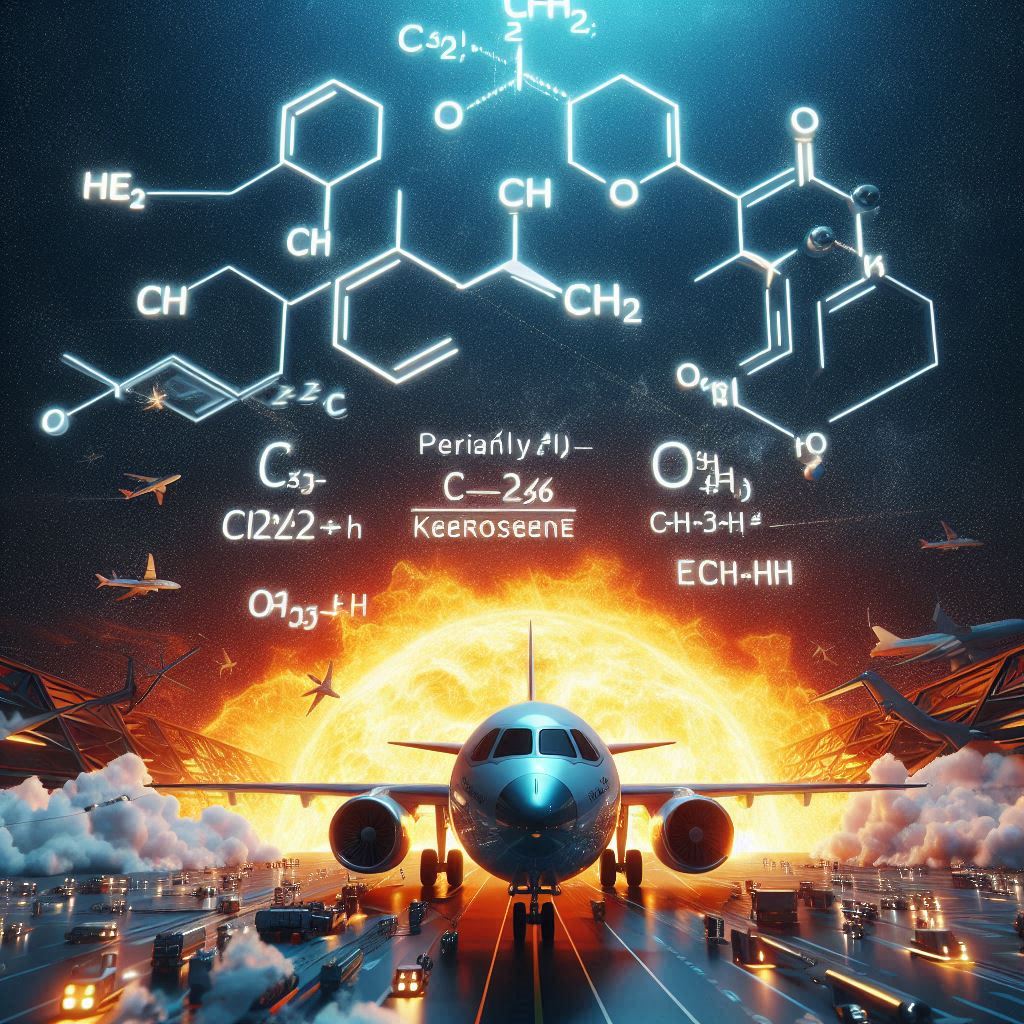
Jet Fuel Chemical Formula for Kerosene Structure
Short Intro
Jet fuel sits at the intersection of chemistry, energy security, and global aviation.
Understanding its chemical formula and structure explains why kerosene remains indispensable to modern flight.
What You’ll Learn
- The chemical formula and hydrocarbon range of jet fuel
- How kerosene’s molecular structure supports jet engine performance
- Why no single chemical equation defines jet fuel
- The combustion reaction that powers aircraft turbines
- How sustainability pressures are reshaping aviation fuels
Introduction: Jet Fuel Chemical Formula for Kerosene Structure
Jet Fuel Chemical Formula for Kerosene Structure
Jet fuel, commonly referred to as aviation turbine fuel, is a refined petroleum product engineered to deliver stable, high-energy combustion under extreme operating conditions. While often summarized by a single representative formula, kerosene-based jet fuel is in reality a carefully controlled mixture of hydrocarbons optimized for safety, efficiency, and performance. Understanding its chemical structure, combustion behavior, and refining logic provides essential insight into why kerosene remains the backbone of global aviation, setting the foundation for deeper analysis in the sections that follow.
2) Jet Fuel Chemical Formula Explained
Jet Fuel Chemical Formula Explained
SEO snippet: Jet fuel does not have a single formula but is commonly represented by C₁₂H₂₆ to describe its dominant hydrocarbon range.
Jet fuel is typically represented by the empirical formula C₁₂H₂₆, corresponding to dodecane, a mid-range alkane that reflects the average molecular weight of kerosene fractions. This shorthand is used for modeling, emissions calculations, and combustion analysis rather than as a literal molecular definition. In practice, aviation fuel contains hydrocarbons ranging from approximately C₈ to C₁₆, balancing volatility, freezing point, and energy density for turbine engines.
From a market perspective, NovinTrades observes that tighter fuel specifications globally have narrowed compositional variance, reinforcing consistency across Jet A and Jet A-1 grades.
Section summary:
The C₁₂H₂₆ formula serves as a practical representation rather than a precise chemical identity. It reflects the controlled hydrocarbon window required for turbine performance and safety.
LSI keywords:
jet fuel formula, C12H26 hydrocarbon, aviation turbine fuel, Jet A composition, kerosene hydrocarbons
External links:
- https://www.iata.org/en/programs/ops-infra/fuel/ (authoritative)
- https://en.wikipedia.org/wiki/Jet_fuel (nofollow, informational)
3) Chemical Formula for Kerosene Jet Fuel
Chemical Formula for Kerosene Jet Fuel
SEO snippet: Kerosene jet fuel belongs to the middle distillate family, dominated by alkanes, cycloalkanes, and limited aromatics.
Kerosene-based jet fuel is refined through fractional distillation of crude oil, targeting a boiling range that ensures both high energy output and operational stability at altitude. While dodecane (C₁₂H₂₆) is often highlighted, the fuel includes straight-chain alkanes, branched isomers, and cycloparaffins that enhance combustion smoothness and cold-flow properties. Aromatics are deliberately limited to control soot formation and emissions.
NovinTrades market analysis indicates that refinery optimization increasingly prioritizes ultra-low sulfur kerosene streams to meet evolving environmental standards without sacrificing engine reliability.
Section summary:
Kerosene jet fuel’s formula reflects a refined balance of hydrocarbon families engineered for altitude, temperature resilience, and regulatory compliance.
LSI keywords:
kerosene chemical formula, Jet A-1 fuel, middle distillates, refinery kerosene, aviation fuel standards
External links:
- https://www.eia.gov/energyexplained/oil-and-petroleum-products/ (authoritative)
4) Chemical Equation for Jet Fuel Combustion
Chemical Equation for Jet Fuel Combustion
SEO snippet: Jet fuel combustion is modeled using a simplified reaction that illustrates energy release rather than exact molecular behavior.
Because jet fuel is a mixture, it cannot be described by a single reaction equation. However, combustion is commonly expressed as:
C₁₂H₂₆ + O₂ → CO₂ + H₂O + energy
This simplified equation illustrates how hydrocarbons oxidize inside turbine combustion chambers, producing high-temperature exhaust gases that drive thrust. In reality, combustion efficiency, pressure ratios, and airflow dynamics determine emissions output more than theoretical stoichiometry.
From a fuel-market standpoint, NovinTrades notes that combustion modeling increasingly informs carbon pricing, lifecycle emissions accounting, and sustainable aviation fuel certification.
Section summary:
The combustion equation is a functional model that explains thrust generation, not a literal chemical breakdown of jet fuel.
LSI keywords:
jet fuel combustion, kerosene oxidation, turbine combustion, aviation emissions, fuel reaction equation
External links:
- https://www.energy.gov/eere/bioenergy/sustainable-aviation-fuels (authoritative)
5) Jet Fuel Chemical Structure and Hydrocarbon Classes
Jet Fuel Chemical Structure and Hydrocarbon Classes
SEO snippet: The chemical structure of jet fuel is defined by hydrocarbon diversity rather than a single molecular arrangement.
Jet fuel contains three primary hydrocarbon classes: straight-chain alkanes for energy density, cycloalkanes for thermal stability, and controlled aromatics for seal compatibility. Molecules such as dodecane, cyclohexane, and trace aromatics collectively define fuel behavior under compression and extreme temperature gradients.
This structural diversity explains why kerosene performs reliably from ground-level ignition to high-altitude cruise. NovinTrades forecasts continued structural tightening of fuel specs as engines become more thermally efficient and emissions-sensitive.
Section summary:
Jet fuel’s molecular structure is intentionally diverse, enabling stable combustion, material compatibility, and performance consistency.
LSI keywords:
jet fuel structure, hydrocarbon classes, alkanes cycloalkanes, aromatic content, turbine fuel chemistry
External links:
- https://www.shell.com/energy-and-innovation/aviation.html (nofollow, informational)
6) Sustainability, Refining Innovation, and Future Fuels
Sustainability, Refining Innovation, and Future Fuels
SEO snippet: Jet fuel chemistry is increasingly shaped by sustainability mandates and alternative fuel development.
While conventional kerosene remains dominant, sustainable aviation fuels are chemically engineered to mimic the same hydrocarbon ranges while reducing lifecycle emissions. Refining advances now focus on hydroprocessed esters, Fischer–Tropsch synthesis, and co-processing bio-feedstocks within existing kerosene streams.
NovinTrades market outlook suggests that chemical equivalence to conventional jet fuel, rather than radical molecular redesign, will define the pace of aviation decarbonization.
Section summary:
Future aviation fuels aim to replicate kerosene chemistry while lowering carbon intensity through feedstock and process innovation.
LSI keywords:
sustainable aviation fuel, SAF chemistry, synthetic jet fuel, bio-kerosene, aviation decarbonization
External links:
- https://www.icao.int/environmental-protection/Pages/SAF.aspx (authoritative)
Conclusion: Jet Fuel Chemical Formula for Kerosene Structure
Jet Fuel Chemical Formula for Kerosene Structure
SEO snippet: Jet fuel chemistry combines controlled hydrocarbon complexity with combustion efficiency to power global aviation.
Kerosene-based jet fuel cannot be reduced to a single molecule or equation, yet its representative formula and structure provide essential insight into how aviation achieves reliable, high-density energy delivery. From refinery distillation to turbine combustion, each chemical decision reflects decades of engineering optimization. As sustainability pressures intensify, the industry’s challenge lies in preserving these chemical fundamentals while reducing environmental impact.
Readers are invited to explore more technical market analyses and in-depth energy articles in the NovinTrades knowledge base and Reportage section.
LSI keywords:
jet fuel chemistry, kerosene aviation fuel, turbine fuel structure, jet fuel analysis, aviation energy
External links:
- https://www.novintrades.com (internal)
- https://www.novintrades.com/reportages (internal)
About NovinTrades
As part of its mission, NovinTrades offers a dedicated Reportage section where businesses, brands, and professionals can publish in-depth sponsored articles, analyses, and thought-leadership pieces. These reportages are SEO-optimized for maximum visibility and long-term engagement.
📍 Explore more at NovinTrades Reportages
📣 Join us on Telegram: https://t.me/novintrades
Reportage Section
As part of this mission, NovinTrades also offers a dedicated Reportage section, where businesses, brands, and industry professionals can publish in-depth sponsored articles, analyses, and thought-leadership pieces. This section is designed to boost online visibility, strengthen brand authority, and drive meaningful engagement with target audiences. Reportages are optimized for SEO and strategically placed on our platform, ensuring long-term exposure to decision-makers and potential buyers across industries.
Visit: https://www.novintrades.com/reportages
Join our Telegram: https://t.me/novintrades