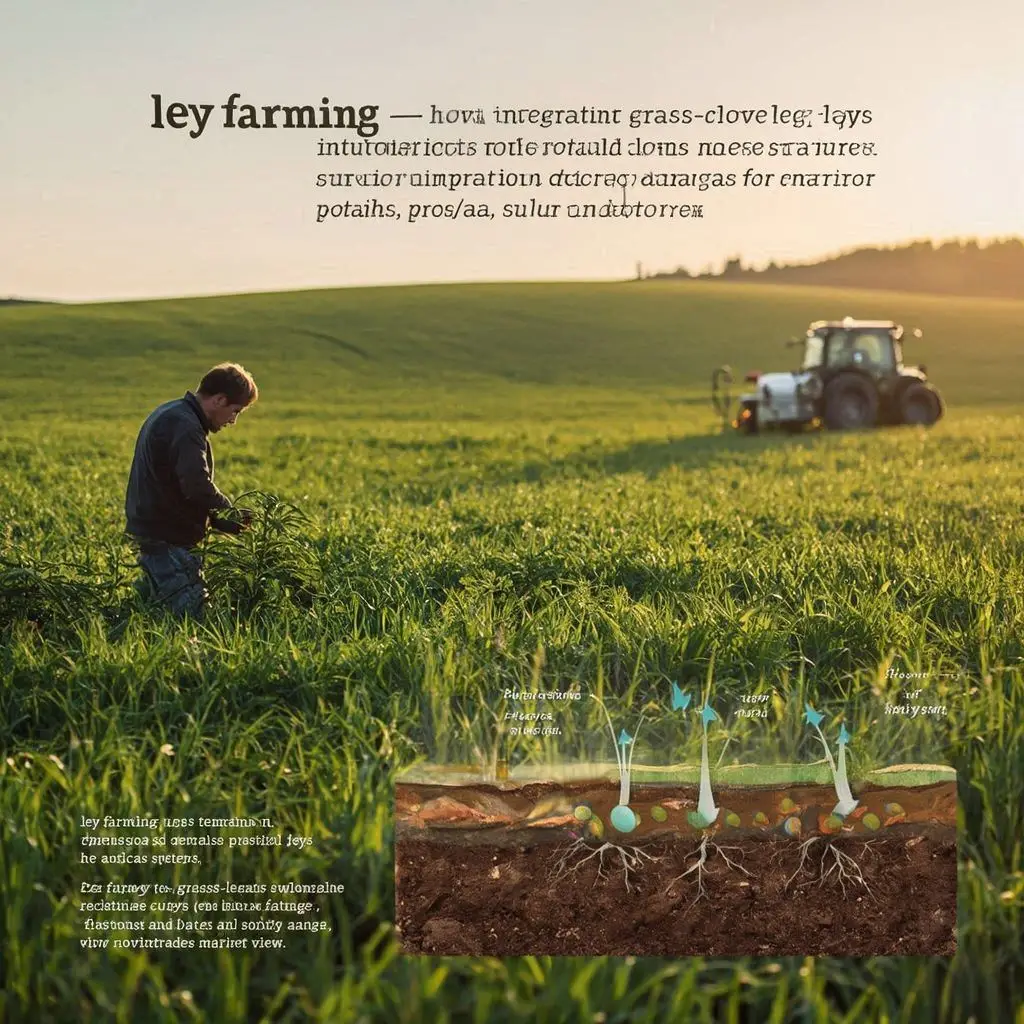
LEY FARMING: HOW GRASS-LEGUME LEYS IMPROVE SOIL, YIELD & FERTILITY
Short intro:
Ley farming uses temporary grass–legume swards (leys) in arable rotations to rebuild soil fertility and supply high-quality forage. Discover how leys reduce synthetic nitrogen needs and interact with urea, sulfur and potash management.
What you’ll learn
- How ley farming works and why farmers use it.
- Practical ley systems and management steps.
- How leys change fertiliser (urea, sulfur, potash) needs and soil nutrient cycling.
- Advantages, constraints, and best-practice recommendations.
- NovinTrades Market View and Forecast for inputs and supply chains.
Key statistics (estimates and benchmarks)
- Biological nitrogen fixation from clover leys can supply 50–200 kg N/ha/year depending on clover proportion and management. FAO AGRIS+1
- Properly managed leys increase soil organic carbon and structure, reducing erosion and often cutting synthetic fertiliser costs by 20–50% for the following cereal crop. AHDB+1
- Grass-clover leys often remove substantial potassium if cut for silage; recommended potash applications depend on soil tests but losses can be significant if exported rather than recycled by grazing. Potash Development Association (PDA)+1
1) INTRODUCTION
SEO snippet: Ley farming is a fertility-building rotation strategy using grass and legumes to supply nitrogen and organic matter while producing forage.
Ley farming (temporary grass–legume swards used within arable rotations) is an established tool to restore soil fertility, control weeds and supply livestock with high-quality forage. Historically rooted in European rotations, modern leys are used for fertility building, weed and disease break, and to reduce dependency on purchased nitrogen fertiliser. Leys are not a one-size-fits-all fix; they work when integrated with clear goals, soil testing and nutrient management. journeytoforever.org+1
External links (section 1):
- Grass leys for the arable rotation — AHDB — https://ahdb.org.uk/knowledge-library/grass-leys-for-the-arable-rotation (target="_blank" rel="nofollow")
2) LEY FARMING
SEO snippet: Ley farming refers to temporary grass or mixed swards grown for a period, then ploughed or grazed as part of a rotation to build soil health and provide forage.
Ley farming covers a range of practices from simple grass–clover swards to diverse herbal leys that include deep-rooting species. Its core purpose is twofold: (1) supply or conserve nitrogen through legumes and (2) rebuild soil structure and organic matter. The ley phase can vary from one year to several years depending on farm objectives (weed control, fertility building, forage production). Louis Bolk Instituut+1
External links (section 2):
- Leys in sustainable farming systems — Louis Bolk Institute — https://www.louisbolk.nl/sites/default/files/publication/pdf/leys-sustainable-farming-systems.pdf (target="_blank" rel="nofollow")
3) LEY FARMING DEFINITION
SEO snippet: A ley is a temporary grassland within a crop rotation, typically a mix of grasses and legumes aimed at fertility-building and forage.
Formally, a ley is a temporary pasture established in arable rotations—sown and kept for a defined period (e.g., 1–5 years). Important components are clovers (red/white) for nitrogen fixation and productive grasses for biomass. The clover proportion dictates the scale of biologically fixed nitrogen available for the following crop; higher clover content equals more N but requires sulfur and other nutrients to function well. FAO AGRIS+1
External links (section 3):
- Grass-clover leys: Agronomy & BNF research — FAO AGRIS — https://agris.fao.org/search/en/providers/122535/records/65df379363b8185d9cabafdd (target="_blank" rel="nofollow")
4) LEY FARMING SYSTEM
SEO snippet: Typical ley systems mix grasses and legumes; options include short-term fertility leys, long-term leys for grazing, and herbal leys for biodiversity.
Common systems:
- Short fertility leys (1–2 years): Rapid build-up of soil N and organic matter before cereals.
- Medium-term leys (2–4 years): Balanced forage production and soil rebuilding.
- Long-term leys (>4 years): Permanent pasture or long-term forage bank.
- Herbal leys: Mixes with deep-rooting herbs to improve resilience and soil structure. Management decisions (grazing vs cutting, sowing date, reseeding) influence nutrient balances and subsequent crop performance. AHDB+1
Practical steps: soil test → choose ley mix → establish with correct seedbed and P/K starter → manage clover proportion through cutting/grazing → terminate at optimal time to transfer N to next crop.
External links (section 4):
- Create and maintain herbal leys — DEFRA Farming Blog — https://defrafarming.blog.gov.uk/create-and-maintain-herbal-leys/ (target="_blank" rel="nofollow")
5) LEY FARMING ADVANTAGES AND DISADVANTAGES
SEO snippet: Leys build nitrogen and organic matter and reduce some input costs — but can export potassium and need careful sulphur and lime management.
Advantages:
- Biological nitrogen supply lowers urea demand for following crops and improves N-use efficiency. RUC Forsk
- Better soil structure, increased organic carbon, reduced erosion and improved water infiltration. Louis Bolk Instituut
- Weed and disease break, improved biodiversity and forage production.
Disadvantages / Risks:
- If leys are cut and removed (silage/hay) rather than grazed, potassium and other nutrients are exported and require potash replacement. Potash Development Association (PDA)
- Legume N fixation requires sulfur; sulfur deficiency reduces clover performance and therefore the ley’s N contribution. Yara United Kingdom
- Time out of the cash crop rotation and potential short-term yield loss for arable output.
External links (section 5):
- Potash for grassland (PDA leaflets) — https://www.pda.org.uk/pda_leaflets/14-potash-for-grassland/ (target="_blank" rel="nofollow")
6) SOIL FERTILITY & FERTILISER INTERPLAY: UREA, SULFUR & POTASH
SEO snippet: Leys influence demand for urea (N), sulfur and potash — clover fixes N (reducing urea), sulfur supports fixation, and potash replaces K removed in forage.
This is the section you asked for explicitly: the practical relationship between leys and the three major fertiliser inputs.
- Urea (Nitrogen): Successful clover-rich leys can supply a measurable portion of the N needed by the following cereal; this typically reduces urea application but does not always eliminate it. Soil tests and crop demand determine the top-up rate; aim to quantify residual soil mineral N before applying synthetic N. FAO AGRIS+1
- Sulfur: Sulfur is crucial for effective biological N fixation by legumes and for protein synthesis in grass. Historic declines in atmospheric S deposition have made soil S more frequently limiting. Applying appropriate S (elemental, gypsum, or sulfate-containing fertilisers) helps maintain clover levels and maximises BNF (biological N fixation). Yara United Kingdom
- Potash (K): Grass and clover uptake and concentrate potassium in stems and leaves; when forage is removed as hay or silage, K is exported from the field. Replacing that K with muriate of potash (MOP) or sulfate of potash (SOP) is often necessary to avoid long-term soil K mining. Grazing systems recycle more K via dung/urine if animals are kept on-field, reducing the need for potash top-up. Potash Development Association (PDA)+1
Quick management checklist: soil test → measure clover share → estimate BNF (use local benchmarks) → adjust urea top-up accordingly → ensure S applications if clover < expectations → plan potash replacement if forage is exported.
External links (section 6):
- Nutrition of grassland (Yara brochure) — https://www.yara.co.uk/siteassets/crop-nutrition/media/uk/uk-agronomy/nutrition-of-grassland-brochure.pdf (target="_blank" rel="nofollow")
7) IMPLEMENTATION & BEST PRACTICES
SEO snippet: Successful leys need planning—site-specific mixes, correct establishment, grazing/cutting strategy and post-ley management to lock in benefits.
Best-practice highlights: base decisions on recent soil tests; prefer mixed grass+clover leys with at least 20–40% clover for meaningful N supply; avoid cutting/clipping too early in the first year; terminate when green bulk and N transfer potential are high (timing depends on crop to follow). Monitor K and S annually and replace removed nutrients if forage is sold off-site. repository.rothamsted.ac.uk+1
External links (section 7):
- Factors affecting N fixation by red clover — Rothamsted Repository — https://repository.rothamsted.ac.uk/item/8595y/factors-affecting-nitrogen-fixation-by-red-clover (target="_blank" rel="nofollow")
8) CASE STUDIES & REAL-WORLD EXAMPLES
SEO snippet: Practical examples show variable N returns from leys; outcomes depend on clover share, harvest method and soil fertility baseline.
Multiple trials and farm-scale studies show a wide range of outcomes — from substantial urea reductions where clover content was high and leys were incorporated, to minimal changes where clover proportion was low or where management limited N transfer. Use local trial data (university/extension) to translate general guidance into farm-specific plans. FAO AGRIS+1
External links (section 8):
- Biological N fixation in grazed ley study — ScienceDirect abstract — https://www.sciencedirect.com/science/article/abs/pii/S1161030101001356 (target="_blank" rel="nofollow")
9) NOVINTRADES INTRODUCTION (BRAND & SERVICES)
SEO snippet: NovinTrades — B2B marketplace for oil products, chemicals and minerals; supply insights, product listings and industry reportages.
NovinTrades is building a next-generation B2B marketplace that connects global buyers and sellers of oil products, chemicals, minerals, building materials and industrial goods. The platform combines product listings, market intelligence and SEO-optimised reportage to help trade partners discover suppliers and expand markets. For readers interested in fertiliser supply (urea, sulfur, potash) and bulk commodity trade, NovinTrades provides product pages and reportages that connect you to suppliers and market insight. Visit product pages for urea and sulfur, browse reportages, and join the NovinTrades community for market updates.
Suggested anchor/link list (SEO safe):
- NovinTrades — Products overview — https://www.novintrades.com/products (target="_blank" rel="nofollow")
- NovinTrades — Reportages (sponsored analyses) — https://www.novintrades.com/reportages (target="_blank" rel="nofollow")
- Urea product page — https://www.novintrades.com/products/24?title=urea (target="_blank" rel="nofollow")
- Sulfur product page — https://www.novintrades.com/products/34?title=sulfur (target="_blank" rel="nofollow")
- Join NovinTrades Telegram channel — https://t.me/novintrades (target="_blank" rel="nofollow")
External links (section 9):
- NovinTrades homepage — https://www.novintrades.com/products (target="_blank" rel="nofollow")
10) NOVINTRADES MARKET VIEW AND FORECAST
SEO snippet: Market view: fertiliser markets remain sensitive to geopolitical supply, shipping costs and demand — leys can reduce reliance on purchased N but potash and sulfur markets still matter.
Market view (summary): Fertiliser markets (urea, potash, sulfur) remain exposed to mining/export policy, shipping costs and energy prices. Ley farming offers farmers a resilience lever by reducing purchased nitrogen demand and improving soil carbon — important if urea supply or price spikes occur. However, potash (K) and sulfur remain critical inputs when forage is exported or soils are S-deficient; plan purchases and contracts via marketplace platforms to secure supply and price transparency. NovinTrades’ product pages and reportage can help sourcing decisions and provide supplier contacts in key regions. (This is a synthesis aimed at practical farm/business decisions rather than price forecasting.)
External links (section 10):
- The future of fertiliser use (POSTnote, UK Parliament briefing) — https://researchbriefings.files.parliament.uk/documents/POST-PN-0710/POST-PN-0710.pdf (target="_blank" rel="nofollow")
CONCLUSION
SEO snippet: Ley farming builds soil fertility and can reduce synthetic N (urea) needs; sulfur and potash management remain essential depending on harvest method and soil status.
Ley farming is a practical, proven strategy for rebuilding soil nitrogen, increasing organic matter and producing forage. Managed correctly, leys reduce dependence on urea, but they raise clear requirements for sulfur (to sustain legume fixation) and for potash (to replace K removed in harvested forage). Implement leys with proper soil testing, a clear management plan, and a fertiliser replacement budget for K and S where relevant. Use marketplaces like NovinTrades to compare suppliers and secure inputs at scale.
LSI Keywords (for on-page SEO)
ley cropping, grass-clover ley, fertility ley, biological nitrogen fixation, clover leys, potash for grassland, sulfur for legumes, reduce urea use, ley rotation benefits, herbal leys, ley establishment, soil organic matter buildup
Expanded FAQs (SEO-rich)
Q: How much urea can a ley replace?
A: That depends on clover proportion, duration and management. Benchmarks suggest 50–200 kg N/ha/yr from clover under good conditions; always confirm with soil mineral N tests before reducing urea. FAO AGRIS+1
Q: Do I still need to apply potash after a ley?
A: If forage is removed (hay/silage), yes—plan potash replacement based on K removal rates and soil tests. Grazing with on-field animals recycles more K, reducing immediate need. Potash Development Association (PDA)
Q: When should I apply sulfur for a clover ley?
A: Apply S at establishment or as a spring top-up if soil tests show low sulfate-S. S is particularly important where atmospheric deposition is low. Yara United Kingdom
Q: How long should a fertility ley be?
A: For rapid soil N build-up, 1–2 years can help; for deeper soil structure and organic matter gains, 2–4 years or more may be appropriate. Choose based on rotation goals.
Q: Are herbal leys worth it?
A: Yes when biodiversity, resilience and deeper rooting are priorities; they often provide better drought resilience and soil structure, although seed cost and management are higher. cotswoldseeds.com