Limestone Formula, Structure & Water Interaction (Class 10)
Short Intro
Limestone is one of the most studied sedimentary rocks in basic chemistry and earth science.
Its formula, structure, and interaction with water explain both natural geology and industrial use.
What You’ll Learn
- The chemical formula and name of limestone
- Molecular and crystal structure of CaCO₃
- Why limestone is included in Class 10 chemistry
- How water forms, alters, and dissolves limestone
- Industrial and environmental relevance of limestone
Introduction
Limestone is a foundational material in geology, chemistry education, and industrial development. Defined chemically as calcium carbonate (CaCO₃), it links basic atomic structure to large-scale geological processes. From Class 10 science curricula to global cement production, limestone provides a clear example of how chemistry operates in nature and industry. Understanding its formula, structure, and interaction with water sets the stage for deeper insight into earth systems and material science.
2) Limestone Formula Name
SEO snippet: Limestone is chemically known as calcium carbonate, represented by the formula CaCO₃, indicating calcium, carbon, and oxygen in fixed proportions.
Limestone’s chemical formula, CaCO₃, represents calcium carbonate, a stable inorganic compound formed through biological and chemical sedimentation. The name “limestone” originates from its historical use in producing lime through heating, a process known as calcination.
Calcium carbonate forms when calcium ions bond with carbonate ions, commonly derived from marine organisms such as corals, foraminifera, and mollusks. Over geological time, these biological remains compact and lithify into limestone deposits. This simple formula explains why limestone is widespread, chemically predictable, and easy to process industrially.
Related keywords: calcium carbonate, CaCO3 formula, limestone chemical name, carbonate rocks
External link: https://www.britannica.com/science/limestone-sedimentary-rock (authoritative geology reference)
NovinTrades Market View: Stable CaCO₃ chemistry underpins limestone’s pricing consistency in construction and cement supply chains.
3) Limestone Formula Structure
SEO snippet: Limestone’s CaCO₃ structure forms a crystalline lattice, most commonly as calcite, influencing hardness, reactivity, and industrial usability.
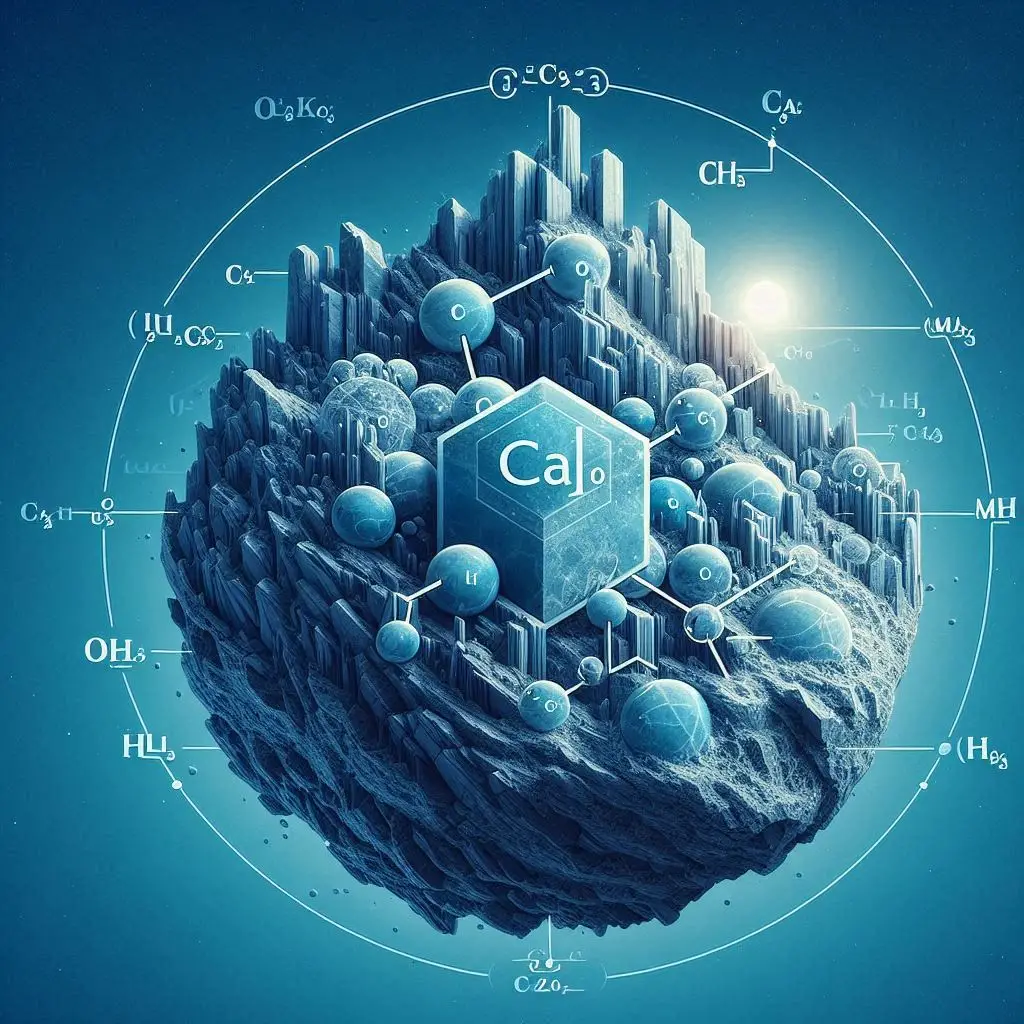
At the molecular level, calcium carbonate consists of one calcium ion bonded to a carbonate group made of one carbon and three oxygen atoms. In nature, these units arrange themselves into crystalline forms, primarily calcite and, less commonly, aragonite.
Calcite crystals form a trigonal lattice that gives limestone its mechanical strength and predictable fracture behavior. This structure also explains limestone’s reactivity with acids, where carbonate ions release carbon dioxide gas. Textural variations such as microcrystalline, fossiliferous, or coarse-grained limestone arise from differences in crystal size and formation environment.
Related keywords: calcite structure, CaCO3 crystal lattice, limestone molecular structure
External link: https://www.mindat.org/min-859.html
NovinTrades Market View: Structural consistency makes limestone a reliable raw material for cement, glass, and flux applications.
4) Limestone Formula Class 10
SEO snippet: In Class 10 chemistry, limestone (CaCO₃) demonstrates sedimentary formation, thermal decomposition, and acid-carbonate reactions.
In secondary education, limestone is introduced as a practical example of a naturally occurring compound with clear chemical behavior. Students learn its formula, formation, and decomposition into quicklime (CaO) and carbon dioxide upon heating.
The Class 10 curriculum uses limestone to connect chemical equations with real-world materials. It illustrates sedimentary rock formation, industrial lime production, and environmental chemistry such as acid rain neutralization. This makes limestone an essential teaching tool linking theory to application.
Related keywords: Class 10 chemistry limestone, calcium carbonate reaction, sedimentary rocks syllabus
NovinTrades Market View: Educational demand mirrors industrial relevance, reinforcing limestone’s role as a core mineral commodity.
5) Limestone Formula and Water Interaction
SEO snippet: Water interacts with limestone through formation, dissolution, and transformation, shaping caves, karst landscapes, and marble deposits.
Water plays a decisive role in limestone’s life cycle. Marine environments provide the dissolved ions necessary for calcium carbonate formation. Over time, water enables compaction, cementation, and crystal growth.
Slightly acidic rainwater dissolves limestone through carbonic acid reactions, producing caves, sinkholes, and underground channels. Under heat and pressure, water-assisted recrystallization transforms limestone into marble. These interactions highlight how CaCO₃ chemistry drives large-scale geological features.
Related keywords: limestone and water, karst formation, CaCO3 dissolution
External link: https://www.usgs.gov/special-topics/water-science-school/science/karst-topography
NovinTrades Market View: Water sensitivity influences quarry planning, environmental compliance, and long-term resource valuation.
Conclusion
SEO snippet: Limestone’s CaCO₃ formula links chemistry, geology, education, and industry through a stable yet reactive mineral system.
Limestone exemplifies how a simple chemical formula underpins complex natural and industrial systems. Its structure explains durability and reactivity, its inclusion in Class 10 education builds foundational understanding, and its interaction with water shapes landscapes worldwide. From academic study to global trade, limestone remains a cornerstone material.
Related keywords: limestone summary, calcium carbonate applications, sedimentary rock chemistry
External link: https://www.geology.com/rocks/limestone.shtml
Readers are invited to explore more educational and market-focused articles in the NovinTrades knowledge base and Reportage section.
About NovinTrades
As part of its mission, NovinTrades offers a dedicated Reportage section where businesses, brands, and professionals can publish in-depth sponsored articles, analyses, and thought-leadership pieces. These reportages are SEO-optimized for maximum visibility and long-term engagement.
📍 Explore more at NovinTrades Reportages
📣 Join us on Telegram: https://t.me/novintrades
Reportage Section
As part of this mission, NovinTrades also offers a dedicated Reportage section, where businesses, brands, and industry professionals can publish in-depth sponsored articles, analyses, and thought-leadership pieces. This section is designed to boost online visibility, strengthen brand authority, and drive meaningful engagement with target audiences. Reportages are optimized for SEO and strategically placed on our platform, ensuring long-term exposure to decision-makers and potential buyers across industries.
Visit: https://www.novintrades.com/reportages
Join our Telegram: https://t.me/novintrades