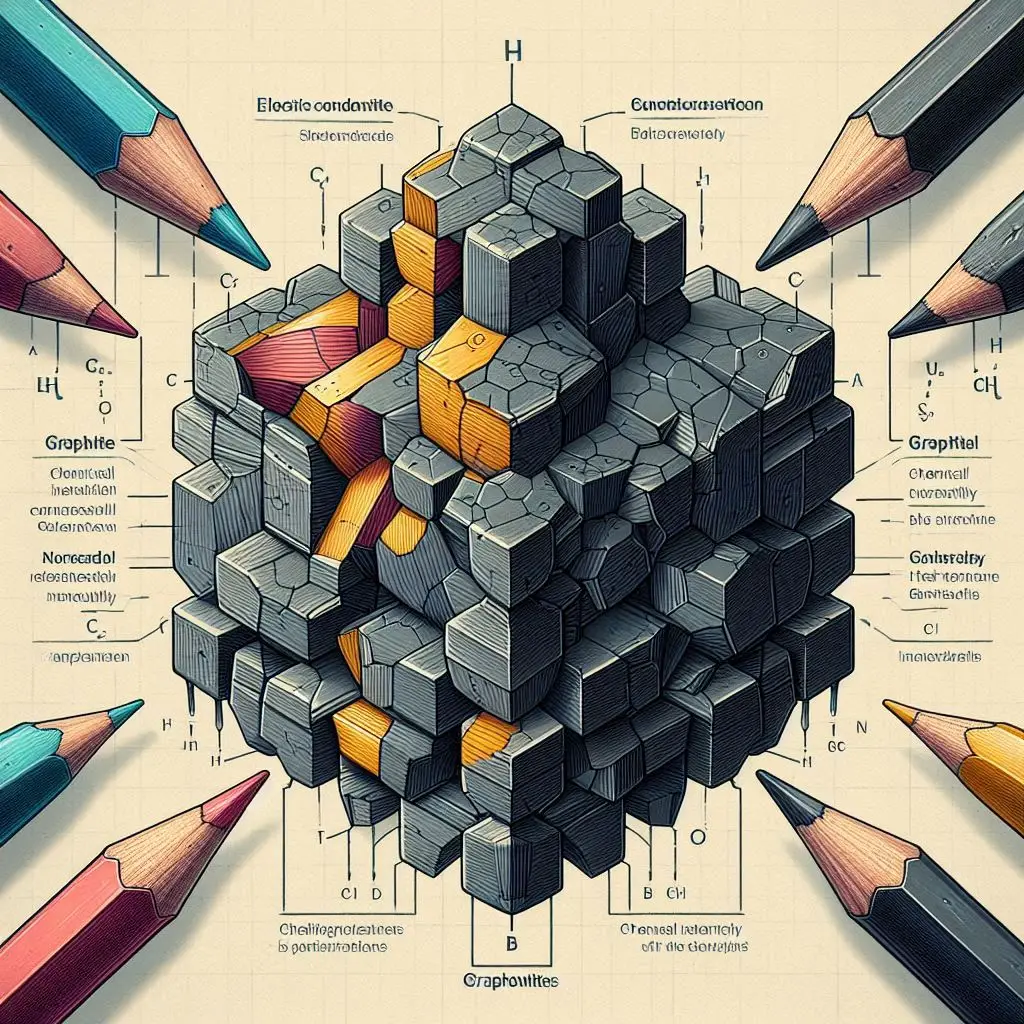
Graphite Formula, Structure, and Carbon Material Insights 2025
Short Intro:
Graphite is more than a pencil core—it’s a versatile carbon material. Learn its structure, properties, and links to carbon black and petroleum coke.
What You’ll Learn:
- Graphite’s chemical formula and hexagonal lattice structure
- Its use in pencils, electronics, and lubrication
- Relationship between graphite, carbon black, and petroleum coke
- Industrial applications and thermal/electrical properties
- Insights into NovinTrades market views and carbon material trends
1) Introduction: Graphite Formula, Structure, and Color Pencil
SEO Snippet: Discover graphite’s structure, formula, and versatile applications in pencils, industry, and advanced carbon materials.
Graphite formula, structure, and color pencil form the cornerstone of understanding carbon’s versatility. Its simple formula, C, conceals a layered hexagonal lattice that gives graphite remarkable mechanical strength, electrical conductivity, and thermal stability. Beyond pencils, graphite is central to lubrication, metallurgy, and electronics. This foundation connects naturally to carbon black pigment and petroleum coke, bridging industrial and artistic uses. Transitioning from pencils to industrial applications reveals graphite’s broader significance.
Keywords: graphite formula, graphite structure, pencil lead, carbon materials, hexagonal lattice, graphite applications, carbon conductivity
External Links: ScienceDirect Graphite Overview, American Carbon Society
2) Graphite Formula and Structure
SEO Snippet: Graphite’s C formula represents a complex layered carbon structure essential for electrical and thermal applications.
Graphite formula and structure define its unique properties. Each carbon atom forms strong covalent bonds in a hexagonal plane, creating graphene layers. Weak van der Waals forces allow these layers to slide, enabling lubrication. The delocalized electrons within layers provide electrical conductivity, while thermal stability makes graphite suitable for high-temperature environments. These structural traits underpin graphite’s use in electrodes, heat sinks, and refractory applications.
Keywords: carbon lattice, graphene layers, delocalized electrons, thermal stability, electrical conductivity, lubrication, crystalline carbon
External Links: Graphite Properties – Britannica, Industrial Carbon Applications
Novin Trades Market View: Graphite demand continues to grow in battery electrodes and industrial lubricants, driven by renewable energy and electronics industries.
3) Graphite Color and Visual Characteristics
SEO Snippet: Graphite appears dark gray to silver-gray, with color influenced by particle size and layer structure.
Graphite color results from light interaction with its hexagonal lattice. Fine particles appear darker, while bulk structures reflect light, creating a metallic sheen. This optical effect is crucial for visual applications like pencil marks, while also providing insight into material quality for industrial uses. Understanding graphite’s color helps differentiate it from carbon black and petroleum coke, which appear darker due to amorphous structures.
Keywords: graphite hue, metallic sheen, particle size, optical properties, carbon color, visual inspection, industrial grading
External Links: Color and Reflectance of Graphite
4) Graphite Pencils and Artistic Applications
SEO Snippet: Graphite pencils combine graphite and clay, offering a range of grades for technical and artistic uses.
Graphite pencils are made by blending powdered graphite with clay, forming leads of varying hardness. Soft leads (B series) provide dark, smooth strokes, while hard leads (H series) ensure precision. This simple tool reflects the adaptability of carbon, bridging artistic expression with technical drawing. Pencil grades are analogous to carbon material grades in industrial applications, where properties are tuned for conductivity, thermal management, or mechanical strength.
Keywords: graphite pencil, pencil grades, artistic tools, technical drawing, clay binder, lead hardness, creative applications
External Links: History of Graphite Pencils
5) Relationship to Carbon Black
SEO Snippet: Carbon black is a high-surface-area carbon material related to graphite, used in pigments, inks, and rubber reinforcement.
Graphite and carbon black share elemental carbon but differ in structure. Graphite is crystalline with layered planes, while carbon black is amorphous with nanoscale domains. Carbon black’s high surface area enhances pigmenting and conductive applications, including inks, coatings, and battery electrodes. Understanding graphite aids in interpreting carbon black’s electrical, thermal, and mechanical behavior. Industries often select between graphite and carbon black based on conductivity, color, or particle morphology.
Keywords: carbon black pigment, amorphous carbon, nanoscale carbon, conductivity, industrial pigments, inks, rubber reinforcement
External Links: Carbon Black Industrial Uses
Novin Trades Market View: Demand for carbon black is rising in automotive tires, 3D printing, and conductive materials, paralleling graphite trends in energy storage.
6) Relationship to Petroleum Coke
SEO Snippet: Petroleum coke is a carbon-rich byproduct of refining, used in fuels, electrodes, and synthetic graphite production.
Petroleum coke and graphite are connected through carbon content and high-temperature processing. Coke is produced from crude oil residues, then calcined to increase carbon content and graphitization. Calcined petroleum coke serves as a precursor for electrodes, bridging the gap between amorphous coke and crystalline graphite. This interrelation highlights carbon’s versatility, from energy applications to advanced manufacturing.
Keywords: petroleum coke, calcined coke, synthetic graphite, carbon-rich residue, electrodes, fuel applications, industrial carbon
External Links: Petroleum Coke Overview – Investopedia
Novin Trades Market View: Calcined coke prices are influenced by aluminum and steel demand, with increasing interest in battery-grade graphite as an alternative feedstock.
7) Conclusion: Graphite Formula, Structure, and Carbon Materials
SEO Snippet: Graphite’s structure underpins its applications in pencils, electronics, and links to carbon black and petroleum coke.
Graphite formula, structure, and color are central to understanding its broad applications. From pencils to industrial electrodes, graphite’s hexagonal lattice enables conductivity, thermal management, and lubrication. Its relationship with carbon black and petroleum coke demonstrates carbon’s adaptability in pigments, fuels, and synthetic materials. For more insights on industrial carbon materials and market trends, explore NovinTrades’ reportages.
Keywords: graphite structure, carbon materials, carbon black, petroleum coke, industrial carbon, conductivity, thermal management
External Links: Industrial Carbon Applications
About NovinTrades
As part of its mission, NovinTrades offers a dedicated Reportage section where businesses, brands, and professionals can publish in-depth sponsored articles, analyses, and thought-leadership pieces. These reportages are SEO-optimized for maximum visibility and long-term engagement.
📍 Explore more at NovinTrades Reportages
📣 Join us on Telegram: https://t.me/novintrades